
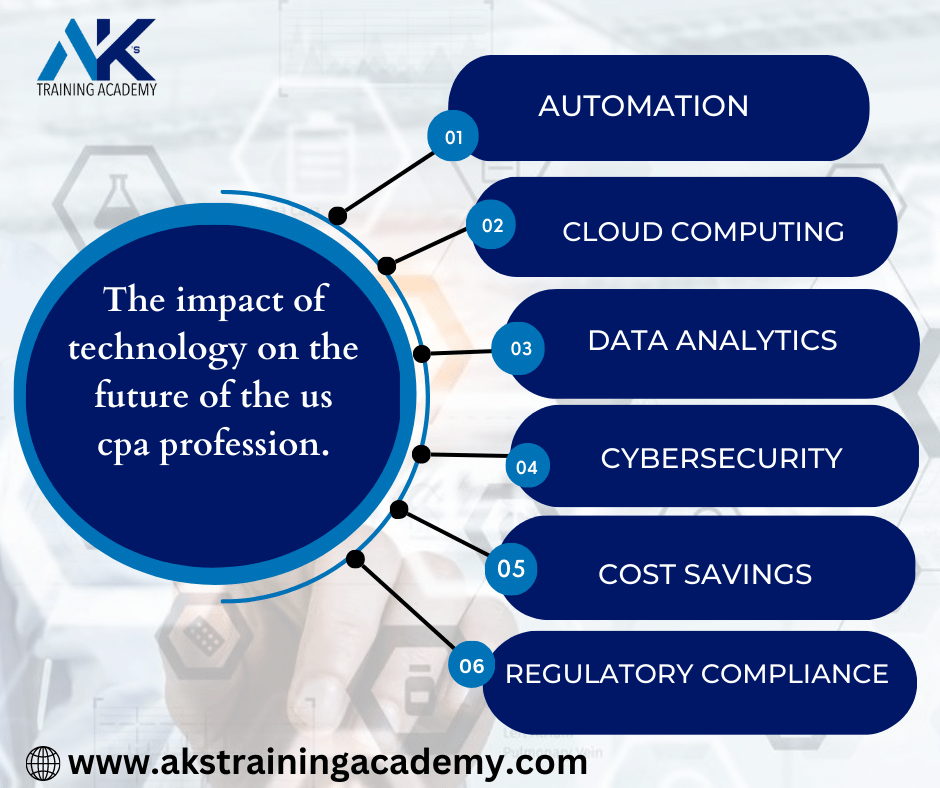
Technology Impact On The Future of The US CPA Profession.
The trajectory of technological growth is not showing any signs of slowing down anytime soon. This unprecedented pace of growth has an impact on all industries, including the accounting profession. As technology evolves, so do the skills and expertise required of accountants. With the rise of automation, cloud computing, data analytics, and cybersecurity, the role of Certified Public Accountant (CPA) is changing rapidly. You may be wondering how these changes will impact the future of the US CPA profession. If technology will make accounting jobs obsolete, or will it create new career opportunities? The accounting profession is experiencing a transformational shift as a result of technology. In this blog post, we will explore the impact of technology on the future of the US CPA profession. Impact 1: Automation You must have heard how industries are looking for ways of automating their production cycle. The same is true for accounting wherein the routine tasks are left to the automated systems. Such tasks as data entry and reconciliations can now be automated, freeing up accountants to focus on more complex tasks. Accountants can now use Machine Learning and Artificial Intelligence to analyze vast collections of data rapidly and without error. They can then use this to identify potential problems and provide solutions driven by analytical insights. More and more functionalities of account keeping are going to be automated in the future. Accountants will need to adapt to keep up with the changes since their role will no longer be limited to data entry. They will need to develop the skill and knowledge of data analysis to remain relevant in the changing times. Impact 2: Cloud Computing Since all data is stored in cloud-based software, accountants have the benefit of accessing financial data from anywhere or anytime. Accountants can thus work remotely which improves their work-life balance. It also helps by reducing the need for physical office space. An accountant’s job is no longer a solitary prospect thanks to cloud computing. It has improved partnerships and communication among accountants, clients, and other stakeholders. Many users can work on one data set simultaneously, thereby improving efficiency and reducing the chances of errors. Impact 3: Data Analytics Data analytics is increasingly becoming a crucial part of the US CPA profession. These professionals have to make sense of large chunks of data and provide insights to businesses to avoid risks. Data Analytics software has made their job easier, as it can study data quickly and precisely. This software can also detect fraud, identify trends, and thus help to make informed business decisions. Accountants will need to understand how to work with data analytics tools and be able to communicate the insights they generate to clients and other stakeholders. As more and more use of data analytics becomes prevalent, accountants will need to upgrade themselves. They will need to learn how to run data analytic tools and also be able to communicate the insights they have gained with other stakeholders. Impact 4: Cybersecurity Accountants have access to the lifeblood of the company in the form of its financial data. It is their job to protect this sensitive information and prevent any data breaches. There is now an added risk of cyber attacks since most companies store their data in the cloud or on blockchains. If the attacker is successful in breaching through the defenses then the consequences can be severe. As a result, accountants will need to be vigilant about cybersecurity threats and take steps to protect sensitive financial data. This may involve implementing stronger password protocols, using encryption to protect data, and ensuring that all software is up-to-date. Impact 5: Cost Savings Next, technology can create significant cost savings in the accounting profession. Accounting firms and their clients will benefit from the use of automation and cloud computing. These help in reducing the amount of time and resources required for routine tasks. Thus, they can be free to focus on higher-value services. Additionally, because of cloud computing accounting firms don’t have the need for a physical office space. They can save on other overhead costs too, leading to significantly more revenue for accounting firms. This is so because, these cost savings can be passed on to clients, making the services more affordable. Impact 6: Regulatory Compliance Lastly, as more accounting services are being integrated with technology, the need for regulatory compliance has become vital. Accountants need to monitor financial transactions more closely and identify potential issues more quickly. The compliance requirements for accountants ensure that they are meeting the latest standards and regulations. If they fail to comply with these regulations, they will be penalized with serious fines and also cause reputation loss for the firm. To ensure compliance with regulatory requirements, accountants will need to stay up-to-date with the latest regulations and implement best practices for compliance. Also read: Why CA Must Do CPA Course? Know More about CPA Course. Conclusion Thus, you can see that the impact of technology on the US CPA profession presents both challenges and opportunities. Traditional accounting roles are becoming redundant new professionals must explore career opportunities in emerging areas of accounting. Ultimately, the impact of technology on the accounting profession is likely to be positive, leading to cost savings, increased efficiency, and improved job opportunities. By embracing the changes brought about by technology, accountants can position themselves for success in the future.

Why CA Must Do CPA Course? Know More about CPA Course.
Certified Public Accountant (CPA) is a universally accepted classification and a highly regarded certification/designation in the accountancy industry all over the world. In short, just like CA (Chartered Accountant) is a designation provided by the Institute of Chartered Accountants of India (ICAI), CPA is a designation given by the American Institute of Certified Public Accountants (AICPA). Now the question arises why one must even think or choose to do CPA Course after CA, well the simple answer to that is- CAs are experts in taxation, auditing etc. while CPAs are experts in many fields along with taxation and auditing like financial forensics, strategy making etc. The quest for CPA after one completes their CA opens a whole range of worldwide opportunities and makes them eligible to work in foreign companies, MNCs and other institutions that look for the CPA certification as a must. CPA helps broaden the spectrum of a CA and makes them experts in multiple fields within accountancy; this in turn generates better career opportunities and higher wages. Top 6 reasons why CAs must pursue CPA Course Acceptance and Recognition: Getting the CPA designation helps one get globally recognized and accepted. Even in India, many MNCs and companies look for CPA cleared accountants as they look for International Financial Reporting Standards (IFRS) and Generally Accepted Accounting Principles (GAAP or US GAAP) knowledge. Since globalization has boomed in India there has been a drastic increase in Indian companies looking for international accounting knowledge in accountants. Global Opportunities: Because CPAs are certified by the AICPA, they gain preference by MNCs and have the freedom to practice globally. By being internationally recognized, you get better salaries and perks and also are known as a dual-certified professional which brings a favoring addition to your profile. CPA course is globally recognized because accountants who clear this course gain knowledge of accounting practices and standards which are universally followed and practiced. Convenience: After one clears their CA in India, clearing the CPA is relatively easy and less time draining. Learning and understanding the CPA syllabus becomes easier under the right training and less time taking after clearing the CA. Once the CPA course is cleared, you understand and can work in different spectrums like forensic accounting, Tax, and Financial Planning, Assurance services, Internal and external auditing, etc. making you multi-faceted with additional knowledge and skills. Specialist Services: In some specific areas, only CPAs can give services and not CAs. Hence clearing CPA after CA makes you a specialist in many ways which paves the way for your career to sustain better. CPAs guide companies through assessments of risks, revisions in handling data and technology etc. The CPA certification gives windows of opportunities to work for big leagues and earn hefty amounts of money. Career Security: Having cleared the CPA, one will never have to worry about job security as clearing the CPA course gifts you with additional skills and knowledge that is always on the lookout by companies and MNCs. Just by doing CA does not assure you big pay or security, but having dual-certification in CPA does. The wide array of skill sets that CPAs learn and understand easily makes them in high demand because that knowledge and practice is globally followed. During harsh or rough economic times, CAs are the most affected and that too an average one. Having the CPA certification on your side keeps you floating even during economic crisis. Endless Learning Opportunity: Since the digital era has hit the accounting industry, the role of AI, significance of IT and continuous changes in tax codes makes learning a never ending loop for accountants. Because of the dynamic nature of the finance and accounting industry, the procedures, laws and regulations are in a constant shift. Since CPAs are at the top of this industry, it becomes a duty to know about the changes and shifts in the accounting sector of the world and this keeps duty keeps the CPAs up to date and boosts the knowledge and profile of an accountant. With this we have covered the crucial and meaningful aspect of why one must clear CPA after clearing their CA. CPA Course Exam Pattern The CPA course exam consists of 4 tests or papers, which can be completed in 18 months or less depending on one’s pace. But for a CA completing this course becomes relatively easy. (CPA Subjects and syllabus) Cost of CPA Course / How much CPA course costs in India? For an Indian student, the overall price of the US CPA Course Exam procedure is sometimes divided into three parts: Cost Of Training: The typical training costs for a live CPA course are closer to INR 105000–115000. The advantage of this is that the recorded videos may be viewed an unlimited number of times, and there are 6500 MCQs and 3000 SIMs that can be used to assist candidates pass the 50% objective CPA test. Evaluation Fees: The evaluation fee, which is payable to the assessment agency to determine eligibility to take the CPA examination, is approximately 22000–23000 INR. Exam Fees: Approximately 185000 INR totals the exam fee plus the cost of the foreign examination. Hence, the typical price in India for the full US CPA programme is between 3.5 and 3.6 lakhs INR. CPA Course Eligibility Criteria : US CPA needs 5 years of education from a recognized institute. They call it the CPA Credit score. Many institutes assist students in evaluating their performance. You will be advised to apply in a specific state based on your score. (US state) CPA Course Duration In order to complete the curriculum, a student must pass 4 papers in 18 months. Candidates will qualify for the CPA Certification if they receive a score of 75 percent or above. Candidates and applicants have to complete their course within a span of 18 months. Job Opportunities For CPA Qualifiers / CPA career opportunities CPA Course truly opens up the world of opportunities. CPAs work on strategically important units in organization.