

CMA USA for Entrepreneurs: How this Certification Can Benefit Business Owners
In the fast-paced world of entrepreneurship, business owners are constantly seeking ways to gain a competitive edge and drive sustainable growth. One often overlooked tool in the entrepreneur’s arsenal is the Certified Management Accountant (CMA) USA certification. While traditionally associated with finance professionals in corporate settings, the CMA certification offers a wealth of benefits for entrepreneurs looking to take their business to the next level. Let’s explore how the CMA USA certification can benefit business owners and contribute to their success. Financial Expertise: Entrepreneurs wear many hats, but few are as critical as that of the finance function. As the financial stewards of their businesses, entrepreneurs must possess a solid understanding of financial concepts, budgeting, forecasting, and financial analysis. The CMA USA certification equips entrepreneurs with the financial expertise needed to make informed decisions, manage resources effectively, and optimize profitability. Strategic Decision-Making: Successful entrepreneurship requires more than just number-crunching—it requires strategic vision and decision-making. The CMA USA certification goes beyond technical skills to develop critical thinking, problem-solving, and strategic planning abilities. Entrepreneurs with a CMA certification are better equipped to analyze market trends, identify growth opportunities, and formulate strategic plans to position their businesses for success. Cost Management: Controlling costs is a perennial challenge for entrepreneurs, especially in the early stages of business development. The CMA USA certification emphasizes cost management techniques, variance analysis, and performance evaluation, helping entrepreneurs identify cost-saving opportunities and optimize resource allocation. By implementing effective cost management strategies, entrepreneurs can improve profitability and enhance their business’s financial health. Risk Management: Entrepreneurship inherently involves risk, but successful entrepreneurs know how to mitigate and manage risk effectively. The CMA USA certification covers risk assessment, risk mitigation strategies, and internal control mechanisms, providing entrepreneurs with the tools to identify and manage risk factors that could impact their business’s success. By proactively managing risk, entrepreneurs can safeguard their business’s assets and reputation and minimize potential liabilities. Investor Confidence: For entrepreneurs seeking external funding or investment, having a CMA USA certification can instill confidence in potential investors. The rigorous curriculum and global recognition of the CMA certification demonstrate a commitment to excellence, professionalism, and ethical conduct. Entrepreneurs with a CMA certification are perceived as credible and trustworthy stewards of investor capital, making them more attractive candidates for financing and partnership opportunities. Business Valuation and Exit Planning: At some point, many entrepreneurs will consider exiting their business, whether through a sale, merger, or succession plan. The CMA USA certification provides entrepreneurs with the knowledge and skills to assess business value, conduct financial due diligence, and develop exit strategies. By understanding the financial aspects of business valuation and exit planning, entrepreneurs can maximize the value of their business and achieve a successful transition. Conclusion: Unlocking Entrepreneurial Success with CMA USA In conclusion, the Certified Management Accountant (CMA) USA certification offers myriad benefits for entrepreneurs seeking to excel in today’s competitive business landscape. From financial expertise and strategic decision-making to cost management, risk mitigation, and investor confidence, the CMA certification equips entrepreneurs with the skills and knowledge needed to drive business growth and achieve their goals. By investing in their professional development and obtaining a CMA certification, entrepreneurs can unlock new opportunities, mitigate risk, and position themselves for long-term success in entrepreneurship.

ACCA Ethics Module: Why Integrity is Essential for Accountants
In the realm of accountancy, integrity is not just a desirable trait—it’s an absolute necessity. The Association of Chartered Certified Accountants (ACCA) recognizes the paramount importance of ethical conduct in the profession, as evidenced by its dedicated Ethics and Professional Skills module. In this blog post, we’ll delve into why integrity is essential for accountants, exploring the significance of the ACCA Ethics Module and its role in shaping ethical leadership in the accounting profession. Maintaining Trust and Confidence: Integrity lies at the heart of maintaining trust and confidence in the accounting profession. Clients, employers, investors, and the public at large rely on accountants to uphold ethical standards and act with honesty and transparency. The ACCA Ethics Module emphasizes the importance of integrity in fostering trust, integrity, and accountability in financial reporting, ensuring the reliability and credibility of financial information. Upholding Professionalism and Reputation: Accountants are entrusted with sensitive financial information and tasked with making critical decisions that impact stakeholders’ interests. Integrity is essential for maintaining professionalism and safeguarding the reputation of the profession. Through the ACCA Ethics Module, accountants are equipped with the knowledge, skills, and ethical principles necessary to navigate complex ethical dilemmas, uphold professional standards, and act in the best interests of their clients and the public. Compliance with Legal and Regulatory Requirements: Accountants operate within a framework of legal and regulatory requirements designed to promote transparency, accountability, and ethical conduct in financial reporting and business practices. The ACCA Ethics Module familiarizes accountants with relevant laws, regulations, and ethical guidelines governing the profession, ensuring compliance with legal and regulatory requirements and mitigating the risk of ethical lapses or misconduct. Fostering Ethical Leadership and Decision-Making: Integrity is a hallmark of ethical leadership, guiding accountants in making principled decisions and upholding ethical values in their professional conduct. The ACCA Ethics Module emphasizes the importance of ethical leadership, encouraging accountants to demonstrate integrity, fairness, and accountability in their interactions with clients, colleagues, and stakeholders. Contributing to Public Interest and Social Responsibility: Accountants play a vital role in promoting the public interest and advancing social responsibility through their ethical conduct and commitment to integrity. By adhering to ethical principles and values, accountants contribute to the greater good of society, instilling confidence in financial markets, facilitating economic growth, and promoting ethical behavior in business and governance. Conclusion: Integrity is the cornerstone of the accounting profession, underpinning trust, professionalism, and ethical leadership. The ACCA Ethics Module plays a pivotal role in cultivating integrity among accountants, equipping them with the knowledge, skills, and ethical mindset necessary to navigate complex ethical challenges and uphold the highest standards of integrity and accountability. As stewards of financial integrity and guardians of public trust, accountants have a moral and professional obligation to act with integrity, ensuring the credibility, reliability, and ethical integrity of the profession now and in the future.

Choosing Pune: The Rising Hub for ACCA, CMA and CFA Education
In the heart of India, amidst the rich cultural tapestry and burgeoning tech landscape, lies a city that is fast becoming the epicentre of excellence in finance education. Pune, often hailed as the ‘Oxford of the East,’ is now emerging as a rising hub for aspirants seeking ACCA, CMA, and CFA qualifications. In this article, we unravel the reasons why choosing Pune is not just a decision; it’s a strategic move towards a future of financial prowess. Academic Ecosystem: Pune boasts a vibrant academic ecosystem, home to renowned institutions that have positioned themselves as leaders in finance education. The city’s educational infrastructure is well-equipped to nurture the inquisitive minds of ACCA, CMA, and CFA aspirants, providing them with a holistic learning environment. Global Recognition Meets Local Advantage: As the demand for global qualifications like ACCA, CMA, and CFA grows, Pune stands out by offering these courses with a local touch. The city provides a unique blend of global curriculum delivery and the advantage of understanding the intricacies of the Indian financial landscape, preparing students for success on a global stage. Industry Connect: Pune’s strategic location, home to numerous multinational corporations and thriving industries, translates into unparalleled industry exposure for finance students. The city’s close proximity to financial hubs ensures that ACCA, CMA, and CFA students have ample opportunities for internships, networking, and real-world application of their knowledge. Affordable Living with Quality Education: Pune offers a cost-effective living arrangement without compromising on the quality of education. Aspiring finance professionals can pursue ACCA, CMA, and CFA qualifications without the financial burden often associated with studying in major metropolitan cities, making education accessible without sacrificing excellence. Tech and Finance Synergy: Known as the ‘Detroit of the East’ for its thriving automotive sector, Pune is also making a mark in the tech industry. The synergy between technology and finance is palpable, providing a unique advantage for ACCA, CMA, and CFA candidates who can harness both skill sets for a dynamic career in the evolving financial landscape. Cultural and Lifestyle Appeal: Beyond academics, Pune’s cultural diversity and vibrant lifestyle contribute to a well-rounded student experience. The city offers a perfect blend of academic focus and recreational opportunities, ensuring that students pursuing ACCA, CMA, and CFA qualifications not only excel in their studies but also enjoy a fulfilling lifestyle. Conclusion: Pune, with its academic excellence, global perspective, industry connect, affordability, and cultural richness, stands tall as a rising hub for ACCA, CMA, and CFA education. Choosing Pune is not just a geographical decision; it’s a strategic move towards a future where finance professionals are not just educated but groomed for global success. As the city continues to rise, so do the opportunities for those seeking to excel in the dynamic world of finance.

Inside Pune’s ACCA and CMA Classes: A Student’s Journey to Financial Excellence
In the vibrant city of Pune, a silent revolution is taking place within the walls of ACCA and CMA classrooms. As students embark on their journey toward financial excellence, their experiences unfold a narrative of growth, challenges, and the transformational power of professional education. Let’s step into the shoes of these aspiring finance professionals and explore Pune’s ACCA and CMA classes through their eyes. The Pinnacle of Learning in Pune Pune, with its vibrant educational landscape, has emerged as a hub for finance professionals seeking the pinnacle of learning through ACCA and CMA classes. These programs are not just courses; they are gateways to a world of international finance, and students in Pune recognize the transformative impact awaiting them. International Expertise in Local Classrooms One of the key attractions of ACCA and CMA classes in Pune is the infusion of international expertise into local classrooms. As students delve into complex accounting principles and financial management strategies, they benefit from the insights of faculty members with global exposure. This exposure is invaluable, offering a well-rounded perspective that extends beyond textbook theories. Practical Application Takes Center Stage In Pune’s ACCA and CMA classes, theoretical knowledge is not confined to textbooks; it comes alive through practical application. Workshops, case studies, and simulation exercises bridge the gap between theory and real-world scenarios. Students find themselves immersed in situations mirroring those they will encounter in their future careers, fostering a deeper understanding of the subject matter. A Diverse Cohort: Pune’s Melting Pot of Talent Pune’s ACCA and CMA classrooms are a melting pot of talent, bringing together individuals from diverse backgrounds, industries, and experiences. This diversity enriches classroom discussions, providing students with insights into the multifaceted nature of the finance profession. Collaborating with peers from different walks of life prepares them for the dynamic and global nature of the finance industry. Challenges and Triumphs: A Student’s Perspective No educational journey is complete without its share of challenges and triumphs. Students in Pune’s CMA and ACCA classes navigate through rigorous coursework, demanding exams, and tight schedules. Yet, these challenges are met with determination and resilience. Each triumph in the form of a passed exam or a successfully completed project becomes a stepping stone toward a brighter financial future. Industry-Relevant Skills: Bridging the Gap to Employment Pune’s ACCA and CMA classes are not solely focused on academic achievements; they are designed to bridge the gap between education and employment. Students graduate not only with a certificate but with industry-relevant skills that make them stand out in the competitive job market. The emphasis on practical skills ensures that they are job-ready from day one. Networking Opportunities: Building Connections for Life The significance of networking is not lost on students in Pune’s ACCA and CMA classes. Beyond the classroom, these programs provide ample opportunities for networking with professionals, alumni, and industry experts. Building connections during the course becomes a cornerstone for future career growth, mentorship, and collaborative ventures. The Transformative Impact: From Student to Financial Professional As students progress through ACCA and CMA classes in Pune, a transformation occurs. They evolve from eager learners to skilled financial professionals with a global mindset. The holistic education they receive equips them not just with technical knowledge but also with critical thinking, adaptability, and a commitment to ethical practices—qualities essential for success in the ever-evolving world of finance. Conclusion: Pune’s ACCA and CMA Classes – A Launchpad to Success In the heart of Pune, ACCA and CMA classes are shaping the next generation of financial leaders. Through a combination of international expertise, practical application, and a commitment to student success, these programs serve as a launchpad to a world of opportunities. As students graduate, they carry with them not just a qualification but a transformative experience that propels them toward a promising career in finance. The journey from a student’s perspective is not just educational; it’s a narrative of growth, empowerment, and the pursuit of financial excellence in the thriving city of Pune.

Balancing Work and CMA USA Exam Prep: Strategies for Working Professionals
Embarking on the journey to become a Certified Management Accountant (CMA) USA is a significant step for professionals seeking to elevate their careers in financial management. However, for those already immersed in the demands of a full-time job, finding the right balance between work responsibilities and CMA exam preparation can be a challenging yet rewarding feat. Here are effective strategies to master the juggling act and successfully navigate both realms. Create a Realistic Study Schedule Establishing a realistic study schedule is the cornerstone of effective exam preparation. Assess your work commitments, identify pockets of time available for studying, and create a schedule that aligns with your energy levels and concentration peaks. Consistency is key, so aim for a study routine that is sustainable over the long haul. Prioritize and Set Clear Goals Identify the most challenging topics or sections of the CMA exam and prioritize them in your study plan. Setting clear goals for each study session helps you stay focused and ensures that you cover all relevant material. Break down your study sessions into manageable tasks, making it easier to track your progress and maintain motivation. Leverage Technology and Study Tools In the digital age, technology can be a valuable ally in your exam preparation journey. Explore online resources, study apps, and forums that cater to CMA exam candidates. Interactive study materials, practice exams, and discussion groups can provide additional support and insights, enhancing your overall learning experience. Engage Your Employer for Support Many employers value professional development and may be willing to support your CMA exam journey. Discuss your aspirations with your employer, and inquire about the possibility of flexible working hours, study leave, or financial assistance for exam fees. Some organizations actively encourage employees to pursue certifications, recognizing the long-term benefits to both the individual and the company. Break Down Large Tasks into Smaller Steps The enormity of preparing for the CMA US exam can be overwhelming, especially for working professionals. Break down the overall preparation process into smaller, more manageable steps. Tackling one topic or module at a time not only makes the journey more digestible but also instills a sense of accomplishment with each completed milestone. Foster a Supportive Network Connect with other CMA candidates, either online or through local study groups. Sharing experiences, challenges, and insights with fellow professionals on a similar journey can provide valuable support. A supportive network can offer encouragement during challenging times and provide different perspectives on study techniques and exam strategies. Practice Time Management During Exam Simulations Time management is crucial during the CMA exam, where each section is timed. Incorporate timed practice sessions into your study routine to simulate exam conditions. This not only helps you become familiar with the pace required but also builds confidence in your ability to complete each section within the allocated time. Embrace a Healthy Work-Life-Study Balance Maintaining a healthy work-life-study balance is vital for overall well-being and sustained productivity. Ensure you allocate time for relaxation, exercise, and leisure activities. A balanced lifestyle enhances your ability to absorb and retain information, ultimately contributing to more effective CMA exam preparation. Conclusion: Navigating the CMA Exam Journey Successfully Balancing full-time work and CMA exam preparation is undoubtedly a challenging endeavor, but with strategic planning, dedication, and a supportive mindset, it’s entirely achievable. Remember, the journey toward becoming a CMA is not a sprint but a marathon. By implementing these strategies, you can navigate the dual responsibilities of work and exam preparation, setting the stage for success in both your professional career and your pursuit of the prestigious CMA USA certification.

Career Spotlight: How ACCA Opens Doors to High-Paying Accounting Roles
The Association of Chartered Certified Accountants (ACCA) is a globally recognized professional accounting qualification that opens doors to high-paying accounting roles and offers numerous career opportunities. Here’s a spotlight on how ACCA can help you achieve a rewarding career in the field of accounting: Global Recognition: ACCA is a respected and internationally recognized qualification. It’s acknowledged by employers in over 180 countries, making it a valuable credential for those seeking opportunities both locally and abroad. Versatile Skill Set: ACCA equips you with a wide range of skills, including financial management, taxation, auditing, and strategic business leadership. This versatility enables ACCA professionals to take on various roles in accounting and finance. High Demand: Accounting and finance are core functions in any business or organization. As a result, there is a constant demand for qualified accounting professionals, including ACCA members, who can provide financial expertise and guidance. Competitive Salaries: ACCA professionals often command higher salaries than their non-certified counterparts. The qualification demonstrates a commitment to excellence and a deep understanding of accounting principles, which employers value. Diverse Career Paths: ACCA opens doors to diverse career paths in accounting, including but not limited to roles in public accounting, management accounting, taxation, forensic accounting, and more. You can choose a path that aligns with your interests and career goals. Career Progression: ACCA provides a structured pathway for career progression. As you gain experience and demonstrate your expertise, you can move into senior positions such as finance manager, chief financial officer, or partner in an accounting firm. Networking Opportunities: ACCA offers access to a vast network of professionals, including fellow ACCA members, which can be invaluable for career development. You can attend events, seminars, and conferences to expand your professional network. Continuous Learning: The ACCA qualification encourages lifelong learning and professional development. You’ll need to complete continuing professional development (CPD) requirements to stay up to date with industry trends and maintain your ACCA membership. Ethical Focus: ACCA places a strong emphasis on ethical behavior and professional values, which is vital in the world of accounting and finance. Employers value ACCA members for their commitment to upholding ethical standards. Job Security: In an ever-changing business landscape, organizations rely on skilled accountants to help them navigate financial challenges. This can provide a level of job security for ACCA professionals, especially if they stay updated with industry developments. In conclusion, ACCA is a powerful qualification that can significantly enhance your career prospects in the accounting field. It not only opens doors to high-paying roles but also provides a solid foundation for a successful and fulfilling career in accounting and finance. If you aspire to work in this field, ACCA can be a key stepping stone to your professional goals.

Certifications that Add Value to Your B.Com Degree
Are you a recent B.Com graduate wondering how to give your career the boost it needs? You’re in the right place! While a Bachelor of Commerce degree provides a solid foundation in business and finance, obtaining additional certifications can be the key to unlocking exciting career opportunities and higher earning potential. In this article, we’ll explore four certifications that can significantly add value to your B.Com degree and help you stand out in the competitive job market. ACCA Course: Mastering Global Accounting Standards The Association of Chartered Certified Accountants (ACCA) is a globally recognized certification for accounting professionals. It equips you with in-depth knowledge of international financial reporting standards, taxation, auditing, and more. Earning an ACCA qualification demonstrates your commitment to becoming a proficient accountant and enhances your career prospects both locally and internationally. US CMA Course: Becoming a Financial Management Expert The Certified Management Accountant (CMA) credential offered by the Institute of Management Accountants (IMA) focuses on financial management and cost accounting. If you aspire to excel in financial planning, analysis, and strategic decision-making, the US CMA course is your pathway to expertise. It’s highly regarded in the finance and management fields and can open doors to managerial roles and lucrative opportunities. CPA USA Course: Pinnacle of Accounting Excellence The Certified Public Accountant (CPA) certification from the USA is renowned worldwide as a mark of accounting excellence. It covers various accounting principles, taxation, auditing, and business law. Gaining the CPA designation not only elevates your career but also expands your horizons, as it’s highly respected in the international business community. Whether you aim to work in public accounting, corporate finance, or consulting, the CPA USA course is your ticket to success. Diploma in IFRS: Navigating International Financial Reporting In today’s globalized business landscape, proficiency in International Financial Reporting Standards (IFRS) is a valuable asset. A Diploma in IFRS not only helps you understand these standards but also allows you to apply them effectively. This certification is particularly beneficial if you have ambitions of working for multinational corporations, where IFRS compliance is essential. Why Pursue These Certifications? Enhanced Skills: Each of these certifications provides specialized knowledge and skills that complement your B.Com degree, making you a well-rounded professional. Global Recognition: These certifications are globally recognized, opening doors to opportunities in various countries and industries. Higher Earning Potential: Certified professionals often earn higher salaries than their non-certified peers. These certifications can significantly boost your earning potential. Career Advancement: With these certifications, you become eligible for more senior and specialized roles in accounting, finance, and management. Networking: You’ll join a community of certified professionals, providing valuable networking opportunities. Adaptability: In a rapidly changing business environment, these certifications keep you updated with the latest industry trends and regulations. Conclusion Your B.Com degree is just the beginning of your journey toward a successful career in business, finance, or accounting. By pursuing certifications like the ACCA Course, US CMA Course, CPA USA Course, or a Diploma in IFRS, you not only add value to your education but also position yourself as a highly sought-after professional. These certifications will empower you with the knowledge and expertise needed to thrive in today’s competitive job market and take your career to new heights. So, invest in your future today and embark on the path to success!

Navigating Accounting Qualifications: Choosing Between ACCA and CMA US for Your Career
In the dynamic field of accounting, selecting the right professional qualification is crucial to shaping a successful career. The ACCA (Association of Chartered Certified Accountants) and CMA US (Certified Management Accountant) courses are two prominent options that offer distinct advantages and pathways. This article explores the features, benefits, and considerations of both qualifications to assist you in making an informed choice. ACCA Course The ACCA qualification is a globally recognized certification that covers a wide spectrum of accounting, finance, and business topics. It is designed for professionals aspiring to excel in areas such as financial management, taxation, audit, and advisory services. Key highlights of the ACCA course include: Global Recognition: ACCA holds recognition in over 180 countries, providing a global platform for career opportunities. Comprehensive Curriculum: The ACCA syllabus offers a well-rounded understanding of various financial aspects, making graduates versatile professionals. Flexibility: Its flexible examination structure allows candidates to balance their studies with work commitments. Holistic Skill Set: ACCA equips individuals with skills not only in accounting but also in broader business management and strategic decision-making. CMA US Course The CMA US qualification is tailored for professionals seeking to specialize in management accounting and financial management. It emphasizes strategic planning, analysis, and risk management. Key highlights of the CMA US course include: Management Focus: CMA US concentrates on skills crucial for strategic decision-making within organizations, making it highly relevant for management roles. Industry Demand: Industries requiring in-depth financial analysis, planning, and reporting often highly value CMA-certified professionals. Global Applicability: While not as globally recognized as ACCA, CMA US still has relevance in numerous countries and industries. Niche Expertise: CMA US holders are equipped with specialized knowledge in cost management, performance evaluation, and budgeting. Choosing the Right Path When deciding between the ACCA and CMA US qualifications, consider these factors: Career Aspirations: Clarify whether your desired career trajectory aligns more with traditional accounting and finance roles (ACCA) or management-focused positions (CMA US). Global Outlook: If international exposure is a priority, ACCA’s extensive recognition might be more suitable. Industry Preference: Research industries you wish to work in and ascertain which qualification is more valued and relevant. Study Flexibility: Evaluate whether you need a flexible study schedule (ACCA) or can commit to a more specialized and intensive program (CMA US). Personal Strengths: Reflect on your strengths and areas of interest to determine which qualification complements your abilities. Conclusion Both the ACCA and CMA US qualifications offer distinct advantages, catering to different career aspirations within the accounting and finance realm. While ACCA provides a broader foundation across various financial domains, CMA US delves into management accounting expertise. Consider your long-term goals, preferences, and aptitudes to make an informed decision that aligns with your career ambitions. Ultimately, either path can lead to a rewarding and successful career in the dynamic world of accounting.

Top 5 Career-Oriented Finance Course in Pune
When it comes to career-oriented finance courses in Pune, several options provide valuable knowledge and open doors to lucrative opportunities. Here are the top 5 career-oriented finance courses in Pune: ACCA (Association of Chartered Certified Accountants) Course: The ACCA qualification is globally recognized and focuses on developing comprehensive accounting and finance skills. It covers areas such as financial accounting, management accounting, taxation, and audit. ACCA course in Pune opens doors to a wide range of finance and accounting roles in various industries. Many global organizations prefer ACCA-certified professionals for their expertise in international financial reporting standards. CMA (Certified Management Accountant) US Course: The CMA US certification is highly regarded for professionals in management accounting roles. It emphasizes financial planning, analysis, control, and decision-making skills. CMA US course in Pune equips individuals to support strategic business objectives through their financial expertise. This certification is ideal for those aspiring to work in management accounting positions in Pune’s corporate sector. CPA (Certified Public Accountant) USA Course: The CPA USA qualification is widely recognized and sought after in the field of public accounting. It covers various aspects of accounting, auditing, taxation, and financial reporting. CPAs often work in public accounting firms, performing audits, tax services, and financial consulting. Pursuing the CPA USA course in Pune can lead to excellent career opportunities with local and international accounting firms. CFP (Certified Financial Planner) Course: The CFP certification is designed for professionals who want to specialize in financial planning and wealth management. It equips individuals with the knowledge and skills to assist clients in achieving their financial goals through comprehensive financial planning strategies. CFP certification is valuable for those interested in careers as financial planners, wealth managers, or financial advisors in Pune’s growing financial services sector. CFA (Chartered Financial Analyst) Course: The CFA designation is highly respected in the finance industry, particularly in the field of investment management. It focuses on investment analysis, portfolio management, financial markets, and ethics. CFA charterholders often work as investment analysts, portfolio managers, or research analysts. Pursuing the CFA course in Pune can enhance your career prospects in the investment industry, including asset management firms, banks, and financial institutions. Conclusion: These top 5 career-oriented finance courses in Pune—ACCA, CMA US, CPA USA, CFP, and CFA—offer distinct career paths in finance and accounting. Consider your career goals, interests, and preferred specialization to choose the course that aligns with your aspirations. Each course has its unique focus and benefits, providing opportunities for growth and success in Pune’s dynamic finance sector. Research the specific requirements, curriculum, and career prospects associated with each course to make an informed decision that paves the way for a rewarding finance career in Pune.
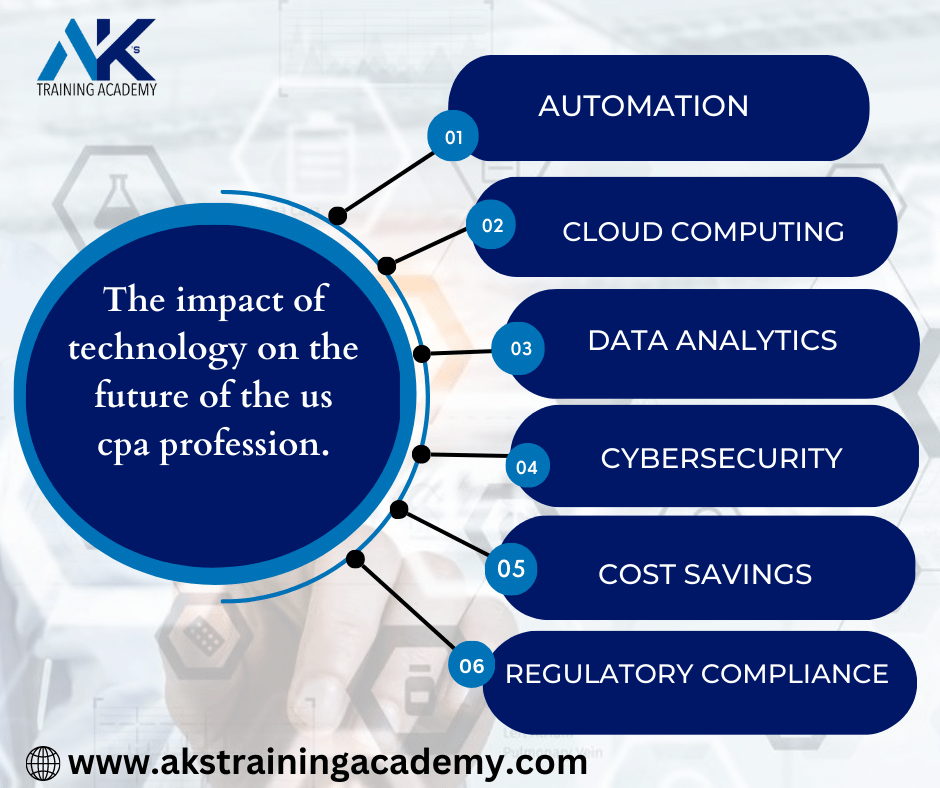
Technology Impact On The Future of The US CPA Profession.
The trajectory of technological growth is not showing any signs of slowing down anytime soon. This unprecedented pace of growth has an impact on all industries, including the accounting profession. As technology evolves, so do the skills and expertise required of accountants. With the rise of automation, cloud computing, data analytics, and cybersecurity, the role of Certified Public Accountant (CPA) is changing rapidly. You may be wondering how these changes will impact the future of the US CPA profession. If technology will make accounting jobs obsolete, or will it create new career opportunities? The accounting profession is experiencing a transformational shift as a result of technology. In this blog post, we will explore the impact of technology on the future of the US CPA profession. Impact 1: Automation You must have heard how industries are looking for ways of automating their production cycle. The same is true for accounting wherein the routine tasks are left to the automated systems. Such tasks as data entry and reconciliations can now be automated, freeing up accountants to focus on more complex tasks. Accountants can now use Machine Learning and Artificial Intelligence to analyze vast collections of data rapidly and without error. They can then use this to identify potential problems and provide solutions driven by analytical insights. More and more functionalities of account keeping are going to be automated in the future. Accountants will need to adapt to keep up with the changes since their role will no longer be limited to data entry. They will need to develop the skill and knowledge of data analysis to remain relevant in the changing times. Impact 2: Cloud Computing Since all data is stored in cloud-based software, accountants have the benefit of accessing financial data from anywhere or anytime. Accountants can thus work remotely which improves their work-life balance. It also helps by reducing the need for physical office space. An accountant’s job is no longer a solitary prospect thanks to cloud computing. It has improved partnerships and communication among accountants, clients, and other stakeholders. Many users can work on one data set simultaneously, thereby improving efficiency and reducing the chances of errors. Impact 3: Data Analytics Data analytics is increasingly becoming a crucial part of the US CPA profession. These professionals have to make sense of large chunks of data and provide insights to businesses to avoid risks. Data Analytics software has made their job easier, as it can study data quickly and precisely. This software can also detect fraud, identify trends, and thus help to make informed business decisions. Accountants will need to understand how to work with data analytics tools and be able to communicate the insights they generate to clients and other stakeholders. As more and more use of data analytics becomes prevalent, accountants will need to upgrade themselves. They will need to learn how to run data analytic tools and also be able to communicate the insights they have gained with other stakeholders. Impact 4: Cybersecurity Accountants have access to the lifeblood of the company in the form of its financial data. It is their job to protect this sensitive information and prevent any data breaches. There is now an added risk of cyber attacks since most companies store their data in the cloud or on blockchains. If the attacker is successful in breaching through the defenses then the consequences can be severe. As a result, accountants will need to be vigilant about cybersecurity threats and take steps to protect sensitive financial data. This may involve implementing stronger password protocols, using encryption to protect data, and ensuring that all software is up-to-date. Impact 5: Cost Savings Next, technology can create significant cost savings in the accounting profession. Accounting firms and their clients will benefit from the use of automation and cloud computing. These help in reducing the amount of time and resources required for routine tasks. Thus, they can be free to focus on higher-value services. Additionally, because of cloud computing accounting firms don’t have the need for a physical office space. They can save on other overhead costs too, leading to significantly more revenue for accounting firms. This is so because, these cost savings can be passed on to clients, making the services more affordable. Impact 6: Regulatory Compliance Lastly, as more accounting services are being integrated with technology, the need for regulatory compliance has become vital. Accountants need to monitor financial transactions more closely and identify potential issues more quickly. The compliance requirements for accountants ensure that they are meeting the latest standards and regulations. If they fail to comply with these regulations, they will be penalized with serious fines and also cause reputation loss for the firm. To ensure compliance with regulatory requirements, accountants will need to stay up-to-date with the latest regulations and implement best practices for compliance. Also read: Why CA Must Do CPA Course? Know More about CPA Course. Conclusion Thus, you can see that the impact of technology on the US CPA profession presents both challenges and opportunities. Traditional accounting roles are becoming redundant new professionals must explore career opportunities in emerging areas of accounting. Ultimately, the impact of technology on the accounting profession is likely to be positive, leading to cost savings, increased efficiency, and improved job opportunities. By embracing the changes brought about by technology, accountants can position themselves for success in the future.